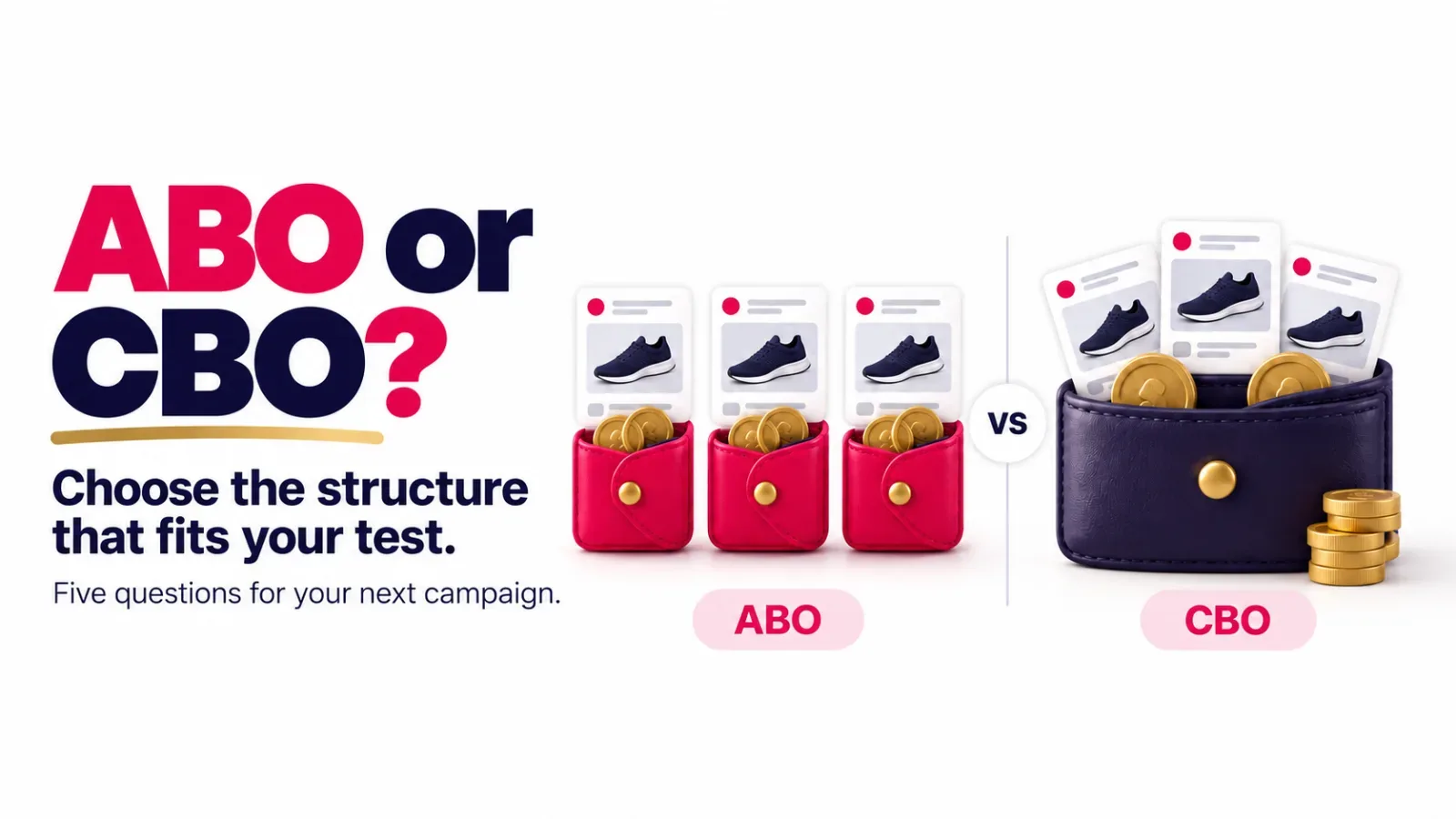
Neither ABO nor CBO wins on its own. The right structure depends on what you know about the creative you are launching, how much risk the business can carry, and what phase it is in.
Every few months a new post claims the debate is settled. One year it is "CBO, one ad set, 50 ads, let Andromeda decide." The next year ABO is back. These posts rarely tell you what the advertiser sells, what they spend, or how many angles they run. Without that context, the advice is noise.
The better framing is a trade-off. CBO usually gives you more efficiency. ABO usually gives you more control and lower risk. Your job is to decide which of those two you need for each batch of ads, not to pick a side for the whole account.
How each structure really spends your money
In a CBO, spend concentrates fast. A common pattern is that 80% of the budget goes to 20% of the ads, and often one or two ads take almost everything.
In an ABO, you set the budget per ad set, so you decide the split. You might give your best ad set 50%, two solid ones 20% each, and keep the rest small or turn them off.
Switch that same account to CBO and the budget usually flows straight to the top performer. That is good for efficiency, because Meta puts money where it sees the best return. It is also risky, because the account now depends on one winner.
What happens when the winner fatigues
Every winning ad fatigues eventually. When it does, a CBO shifts budget to the other ads in the campaign. Those ads never got enough spend to prove themselves, so you are hoping one of them picks up.
Launching a new ad set of fresh creatives into the same CBO every week does not fully fix this. The CBO can keep feeding the top ad, so the new ads stay unproven. You end up with volume but no backup winners.
An ABO lets you force spend into new tests. Over time you build a bench of proven creatives that can take over when the current winner drops.
Spend speed decides how long an ad lives
The same ad with the same total spend can last 7 days or 30 days. The difference is daily spend. Push a winner hard and you compress its life into a short window. Let it run at a steadier daily budget and it lasts longer.
This is a hidden benefit of ABO. Your winners often live longer, which gives you more time to find the next ones.
The one question that decides it
Before you place any new creative, ask: does it make sense to let Meta decide whether this creative gets spend?
- No → you want control. Use ABO.
- Yes → you want freedom. Use CBO.
- Partly → you want both. Use CBO with a minimum spend on each ad set.
The answer depends mostly on how much you already know about the creative. The less you know, the more control you need. The more proof you have, the more freedom you can give.
This question also protects you from trend posts. When someone says "ABO is back" or "one ad set is all you need," you can test the claim against your own situation instead of copying it.
Five scenarios, five answers
The five cases below cover most of what lands on a media buyer's desk. They follow one pattern: the more you know about a creative, the more freedom you give Meta.
1. A brand-new concept you have never tested
Your editor spent six hours on a two-minute animated VSL. You do not know the CTR, the CPM, or whether Meta will even approve it.
Answer: no freedom. Launch it in its own ad set inside an ABO.
If you drop it into a CBO where one ad has already spent $100K, the new ad may get cents over the next month. You will never learn whether it works. Even a CBO with minimum spends has limited slots, usually 5 to 10 ad sets, and an untested idea does not deserve one yet.
2. A proven concept with new volume
Three versions of the animated concept worked in ABO. Your creative strategist now sends 15 new videos built on the same idea.
Answer: some freedom. Use a CBO with ad sets by concept and a minimum spend on each.
You are not testing the concept anymore. You are expanding it, so 15 separate ABO ad sets would waste money. Adding all 15 to an existing CBO ad set with 10 ads is also risky, because nothing guarantees they get spend.
A practical setup: one ad set for real UGC winners, one for the animated concept, each with a minimum of about 10% of the budget. The new videos go into the animated ad set. Every concept gets a floor, and Meta controls the remaining 80%.
3. Small iterations of a winning ad
Your before-and-after ad set is the top performer. The new ads are light edits of the winners: a new headline, a different model, the product moved to the center.
Answer: full freedom. Add them to the winning ad set as a refresh.
These ads target the same audience with the same angle. A new ad set would overlap with the original and compete for the same people. Testing them in ABO also wastes budget, since tests are inefficient by nature. If roughly a quarter of tests win, the other three quarters drag your ROAS down.
4. A short flash campaign
Black Friday, a brand anniversary, a seasonal sale. You have 10 days and 15 different ads.
Answer: partial freedom. Use a CBO with several ad sets and a minimum spend on each.
Both extremes fail here. An ABO with 15 one-ad ad sets is hard to scale with consistency: one ad set runs at $50 a day, another at $225, and results swing daily. A CBO with one ad set and 15 ads lets one ad take most of the budget. If Meta picks the wrong one, you can lose half of a 10-day window waiting for it to correct.
5. Launching something new
A new country, a new product category, or a new brand. You have 10 ads and no idea which angle sells.
Answer: no freedom. Avoid consolidation entirely.
A CBO here wastes time because you do not get clear data fast. Do not worry about the learning phase at this stage either. The rule of 50 conversions per ad set per week is generic advice and does not help when you are still searching for an angle.
The order that works:
- Test angles.
- Test concepts inside the winning angles.
- Consolidate winners into CBO.
- Test bidding strategies.
- Plan flash campaigns and scale.
A diverse structure is not diverse spend
Many accounts look well organized on paper and still depend on a single ad. Structure diversity and spend diversity are two different things.
Picture a CBO with four angles. One angle takes almost the entire budget, while the other three get a few hundred dollars between them. The campaign has four ad sets, but in practice it behaves like one.
If one video takes 99% of the budget, you could have 300 ads sharing the last 1% and it would change nothing. That account will not find stability, because one creative carries all the results.
This is why minimum spends matter. They guarantee each concept a share of the budget, so you get real data on more than one idea.
Not everyone agrees on minimum spends
Some experienced buyers report that ABO beats a CBO with minimum spends, even for the same tests. Their theory is that Meta may give those forced ad sets lower priority in delivery, though nobody has confirmed why. Others use CBO with minimum spends as their main scaling structure and show solid results.
Treat it as something to test in your own account before you roll it out to every client.
When CBO optimizes for the wrong thing
CBO works best when Meta has plenty of signal on your goal. When purchases are few, it starts leaning on earlier metrics: CPC, CTR, hook rate, hold rate, and watch time.
Take three ad sets over a long period. The first returns a ROAS of 5 with a 1% CTR. The second returns 3 with a 0.8% CTR. The third returns 1 with a 4% CTR. With low purchase volume, a CBO can push most of the budget to the third one, because its click metrics look best.
You might assume the third ad set is just reaching warmer retargeting traffic. That is not always the case. Even when all three reach cold audiences, a CBO with weak purchase signal can still favor the one with the best click metrics.
If your average order value is high or your conversion volume is low, be skeptical of CBO and lean toward ABO.
What this means for lead generation
Most of the public debate is about e-commerce with large budgets, where the goal is a purchase. Lead generation in real estate, healthcare, education, or B2B has a different problem.
Lead volume is often high and cheap, so Meta has enough signal. The issue is lead quality. A CBO will move budget to the ad set with the cheapest leads, and in real estate that is often the ad set with the weakest leads.
A few rules help in lead gen accounts:
- If you do not send qualified-lead or sale events back from your CRM, ABO is the safer default. You judge quality yourself before scaling.
- Once you send a downstream signal such as a qualified lead, CBO becomes a much better option, because Meta optimizes for quality, not just volume.
- Minimum spends need budget. On a small account, splitting the budget into several floors can leave Meta almost nothing to work with. Keep fewer ad sets in that case.
Three more factors that change the answer
How profitable the business is
If margins are thin and the business needs raw efficiency now, CBO makes sense. If the business is large and profitable, consistency usually matters more than squeezing out the last bit of ROAS. ABO gives you that by keeping a steady flow of proven creatives.
The season
The right structure can change during the year. In peak months like November, efficiency is the priority, so you consolidate and let the best ads take the budget. In slower months like January and February, you test hard to find the winners you will scale in spring.
The same account can move budget control from the ad set level to the campaign level and back again, depending on the month.
How many ads sit in each ad set
Meta sequences ads at the ad set level. The chance of a purchase drops sharply after someone sees the same creative two or three times. So when Meta thinks a person is still likely to buy, it wants to show them a different ad from the same ad set.
That means each ad set needs some creative variety. Nobody knows the perfect number, but 3 to 6 ads works well, and up to 10 is fine.
- One ad per ad set is too few. Consolidate into fewer ad sets with more ads each.
- 100 ads per ad set is too many. Meta has too many paths to test and can stay stuck in learning.
Cheat sheet
| Situation | Structure | Why | | --- | --- | --- | | New market, product or brand | ABO, one angle per ad set | You need clean data fast, not efficiency | | New, untested concept | New ad set in ABO | It would get almost no spend in a CBO | | Proven concept, new volume | CBO, ad sets by concept, \~10% minimum each | Expansion, not testing; every concept gets a floor | | Small iterations of a winner | Inside the winning ad set | Same audience; a new ad set would overlap | | Flash campaign, short window | CBO, several ad sets with minimums | Scale without betting everything on one ad | | Low conversions or high AOV | Lean ABO | CBO drifts toward click metrics | | Lead gen without CRM signal | Lean ABO | CBO chases the cheapest leads, not the best | | Peak season, thin margins | CBO | Efficiency comes first |
Launching a project this quarter?
30 minutes, no cost. We’ll show you where your cost per lead is leaking.
The bottom line
CBO gives you efficiency and scale, with more risk. ABO gives you control, steadier results, and a pipeline of new winners, with some loss of efficiency.
You do not have to choose one for the whole account. Ask the governing question for every batch of creatives: should Meta decide whether this gets spend? Let what you know about the creative, the business, and the season answer it.